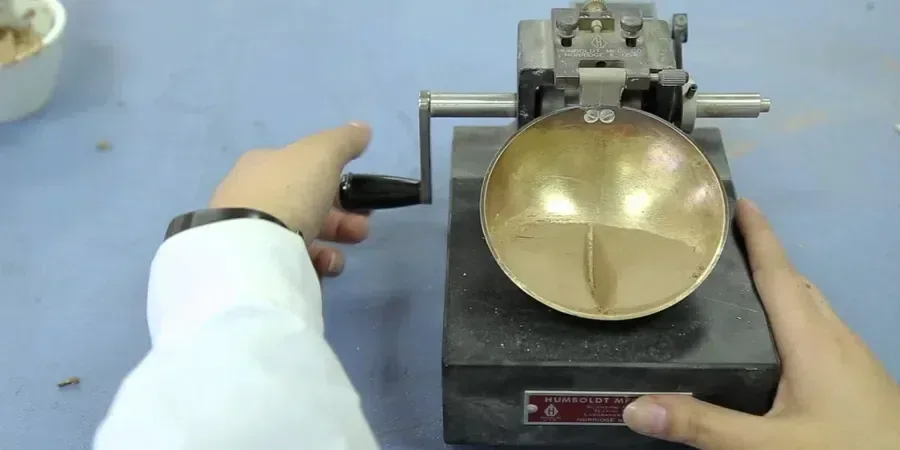
In Akron, the legacy of the Wisconsin glaciation left behind a complex mantle of silty clays and lacustrine deposits that behave unpredictably with seasonal moisture changes. The Cuyahoga River valley and surrounding uplands contain fine-grained soils that can transition from brittle solid to plastic putty within a narrow water content range. A contractor digging a basement in Merriman Valley last spring watched trench walls slump after three days of rain, not because the slope was too steep, but because the clay had crossed its plastic limit. The Atterberg limits test quantifies exactly these transitions: the liquid limit where soil flows under its own weight, the plastic limit where it crumbles rather than deforms, and the shrinkage limit where volume loss stops. ASTM D4318 governs the procedure, and our lab runs it daily on samples from Fairlawn, Ellet, and downtown Akron. We pair Atterberg limits with grain-size analysis to classify the soil per ASTM D2487, and with proctor-tests when the same clay is destined for engineered fill beneath a slab or parking lot.
A plasticity index above 25 in Akron glacial clays is a reliable predictor of seasonal heave: it's not a question of if movement will occur, but by how many inches.
Our approach and scope
Local geotechnical context
The most expensive mistake we see in Akron is assuming a grey silty clay is just 'typical Ohio mud' without quantifying its Atterberg limits. A geotechnical report that skips plasticity testing leaves the structural engineer blind to differential heave potential, and the result surfaces years later as cracked block walls in a Highland Square bungalow or a tilted addition in Wallhaven. The IBC and ASCE 7 classify sites based on soil profile, and expansive clays can bump a project into a more restrictive seismic design category even in Ohio's low-seismicity environment. Foundation drainage details that work fine in granular outwash soils of the Portage Lakes area fail miserably in the plastic clays of North Hill because the water doesn't drain; it gets absorbed, and the soil swells. A split-spoon sample from an SPT borehole may feel firm to the driller's hand, but if the PI comes back at 32, that soil will generate uplift pressures on grade beams that no amount of rebar can ignore.
Regulatory framework
ASTM D4318-17e1, ASTM D2487-17e1, AASHTO T 89 and T 90, IBC 2021 Section 1803
Related services
Complete Atterberg Suite
Liquid limit by Casagrande cup, plastic limit by thread-rolling, plasticity index, liquidity index, and USCS classification per ASTM D4318 and D2487. Includes moisture content determination on the same sample.
Shrinkage Limit Testing
Wax-coated specimen method for determining the shrinkage limit and volumetric shrinkage ratio of fine-grained soils. Commonly specified for clay liner QA/QC in retention ponds and landfill caps in Summit County.
Correlative Index Testing
Activity calculation (PI vs. clay fraction), flow index from the liquid limit flow curve, and toughness index. These parameters help predict mineralogical behavior of Akron's mixed glacial clays without XRD.
Typical parameters
Questions and answers
Why do Akron soils need Atterberg limits testing when I can just use the boring log description?
A visual or tactile field description can identify a soil as 'silty clay,' but it cannot quantify the water content range over which that soil behaves plastically. Two clays that look identical in a split spoon can have PI values of 12 and 35: the first is a stable lean clay suitable for direct bearing, the second is a fat clay that will heave seasonally. The Atterberg limits test provides the numerical data required by IBC 2021 Section 1803 for foundation design on expansive soils, and it is the basis for USCS classification per ASTM D2487.
What does Atterberg limits testing cost for a residential project in Akron?
A complete Atterberg limits test (liquid limit, plastic limit, and plasticity index) on a single sample typically ranges from US$70 to US$110, depending on whether the shrinkage limit and correlative indices are included. Most residential investigations in Akron require 2 to 4 samples taken from different depths within the bearing zone, so the total Atterberg testing component of a geotechnical report usually falls between US$140 and US$440. Expedited turnaround within 24 hours carries a modest surcharge.
How long does it take to get Atterberg limits results from your Akron lab?
Standard turnaround is 3 business days from sample receipt for the full suite (LL, PL, PI, classification). We offer 24-hour expedited service for projects on tight schedules, which is common during Akron's short summer construction window when foundation pours are sequenced back-to-back. The limiting factor is the 24-hour oven-drying step for moisture content determination, which we run overnight regardless of the service tier.