Akron’s terrain tells a story of glacial retreat and river-carved valleys, leaving behind a patchwork of silty clays, tills, and outwash sands that challenge every earthwork contractor. Along the Ohio & Erie Canal corridor and up through the Merriman Valley, the ground beneath the surface can shift from stiff to spongy in less than a hundred feet. That variability is why a standard density check alone rarely tells the full story. The Proctor test delivers a laboratory-defined benchmark for maximum dry density and optimum moisture content, giving site superintendents a clear target when running nuclear gauge or sand cone checks on fill lifts. In a city sitting at roughly 1,000 feet of elevation with freeze-thaw cycles that punish poorly compacted subgrade, hitting that density window matters for pavement life and foundation support alike. For deeper stratigraphic context on a site, we often pair the Proctor with a few test pits to correlate lab values with visible soil fabric before heavy equipment rolls.
Compaction without a Proctor benchmark is like grading without a level: you can move a lot of dirt but you cannot prove it will perform.
Our approach and scope
Local geotechnical context
At 41° north latitude, Akron endures more than 100 freeze-thaw cycles in a typical year, according to NOAA climate records for the region, which means water trapped in poorly compacted fill expands and contracts relentlessly from November through March. Even a 3 percent deviation below optimum moisture during placement can leave enough interconnected voids for ice lensing to heave a slab edge or crack an asphalt pavement within two winters. Another quiet risk is perched groundwater in the weathered till zone: a contractor may compact to spec in dry weather, only to have the moisture content rise after spring thaw and push the soil past optimum, triggering post-construction settlement. A Proctor test run on soils sampled from the actual lift depth, not from a stockpile that has dried out in the sun, gives the most truthful target values. For projects near the Cuyahoga River floodplain, where alluvial silts dominate, we also recommend assessing liquefaction potential when the Proctor results point to low-plasticity fines that could lose strength under seismic or rapid-drawdown loading — Akron sits in a low-to-moderate seismic hazard zone per USGS maps, but the combination of saturated silt and vibration from nearby rail or heavy traffic is not something to ignore.
Regulatory framework
ASTM D698-12 (Standard Test Methods for Laboratory Compaction Characteristics of Soil Using Standard Effort), ASTM D1557-12 (Standard Test Methods for Laboratory Compaction Characteristics of Soil Using Modified Effort), ASTM D4718-15 (Correction of Unit Weight and Water Content for Soils Containing Oversize Particles), ASTM D2216 (Laboratory Determination of Water Content), ODOT CMS 203 (Ohio DOT compaction and embankment specification, where applicable)
Related services
Standard and Modified Proctor Curves
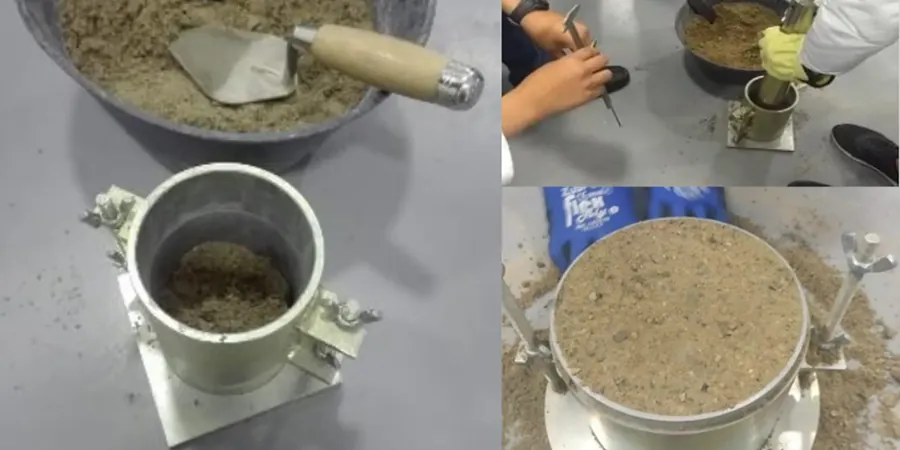
Laboratory determination of moisture-density relationships using ASTM D698 or D1557. We report maximum dry density, optimum moisture content, and the full compaction curve with correction for oversize particles. Typical turnaround is 2–3 business days, with same-day rush available for active earthwork operations in Summit County.
Field Compaction Correlation and QA Support
On-site density testing using nuclear gauge or sand cone methods, tied directly to the laboratory Proctor curve. We provide pass-fail reports per project specifications and can assist with moisture adjustment recommendations when field readings drift outside the 2 percent moisture window.
Typical parameters
Questions and answers
What does a Proctor test cost for a typical site in Akron?
For a single Standard or Modified Proctor curve, budget between US$110 and US$220 depending on whether the soil needs particle-size correction and how many moisture points are required. Most residential pads need one curve per soil type encountered; larger commercial excavations may require two or three curves to cover the variability across the site.
When should I choose Modified Proctor instead of Standard?
Modified Proctor applies whenever the fill will support structural loads, heavy traffic, or deep backfill behind retaining walls. In the Akron area, most commercial building pads and ODOT-influenced road sections default to Modified effort at 98 percent compaction. Standard Proctor is typically reserved for landscape fills, non-structural berms, and trench backfill under sidewalks where lighter compaction equipment is used.
How much soil sample do you need to run a Proctor test?
We ask for approximately 40 to 50 pounds of material in sealed bags or buckets, taken from the actual lift being compacted rather than from a surface stockpile. If gravel or cobbles are present, a larger sample helps ensure we have enough minus-4 or minus-3/4 inch fraction to run the test per ASTM D4718 correction procedures.
Can you use the same Proctor curve for the whole project?
Only if the soil type remains consistent across the site. Glacial till in Akron can change from lean clay to sandy silt within a single excavation bench. When visual classification or field density readings drift unexpectedly, a new Proctor curve on the changed material is the safest way to keep compaction acceptance defensible and avoid costly over-compaction or under-compaction.