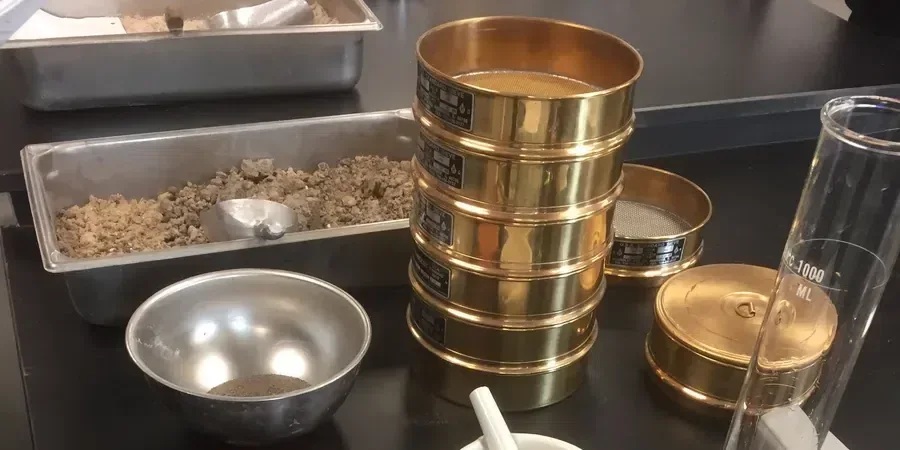
A contractor excavating for a new mixed-use building near the Ohio & Erie Canal hit a layer of fine silt that was not on the preliminary drawings. The material felt stable going in, but water pooled immediately at the bottom of the cut. That is a common scenario across Akron, where glacial lake deposits and alluvial silts create a tricky mix of sands and fines that need precise characterization. A standard grain size analysis resolves the uncertainty. Our lab runs the full mechanical sieve stack per ASTM D6913, then follows with a hydrometer test per ASTM D7928 for the minus No. 200 fraction. The result is a continuous particle size curve that drives everything from drainage design to USCS classification. For jobs where the silt transitions into a lean clay, we often pair the grain-size data with Atterberg limits to lock in the plasticity index before foundation sizing begins.
A single hydrometer point can change a soil classification from silty sand to sandy silt, and that shift rewrites the entire foundation report.
Our approach and scope
Local geotechnical context
Glacially-derived soils in Akron carry a characteristic risk: the coarser fraction often forms an open-work gravel with little to no fine binder, while the finer fraction can be a rock flour that drains slowly. Running only a sieve test on a sample that is 35 percent minus No. 200 leaves nearly half the mass uncharacterized. That gap hides potential frost-susceptible material, and in Summit County the frost penetration depth reaches 40 inches per the Ohio Building Code. A complete grain size analysis with hydrometer catches the silt-clay boundary and identifies gap-graded distributions that are prone to internal erosion. This is especially relevant for retaining wall backfill and underdrain filter design, where the D15-to-D85 ratio between adjacent soils must satisfy the Terzaghi filter criteria. Missing that check can lead to clogged drainage systems and hydrostatic buildup behind basement walls within the first winter.
Regulatory framework
ASTM D6913/D6913M-17: Standard Test Methods for Particle-Size Distribution (Gradation) of Soils Using Sieve Analysis, ASTM D7928-21: Standard Test Method for Particle-Size Distribution (Gradation) of Fine-Grained Soils Using the Sedimentation (Hydrometer) Analysis, ASTM D2487-17: Standard Practice for Classification of Soils for Engineering Purposes (Unified Soil Classification System), AASHTO T 88: Particle Size Analysis of Soils
Related services
Full Geotechnical Index Suite
Combine grain size analysis with Atterberg limits and moisture content per ASTM D2216. This trio gives the complete USCS classification and the soil's engineering name, essential for bearing capacity estimates and foundation design in Akron's glacial soils.
Hydraulic Conductivity Correlation
Use the D10 and D20 from the grain size curve with Hazen's and Kozeny-Carman correlations to estimate saturated permeability. This data supports dewatering plans, stormwater infiltration feasibility, and seepage analysis for excavations near the Cuyahoga River.
Typical parameters
Questions and answers
How much does a grain size analysis cost in the Akron area?
A complete sieve plus hydrometer analysis typically ranges from US$110 to US$180 per sample, depending on whether the material is predominantly coarse or fine. The price covers the full mechanical shaking, hydrometer sedimentation readings at 0.5, 1, 2, 5, 15, 30, 60, 250, and 1440 minutes, and the combined gradation report with Cu and Cc coefficients.
How long does it take to get the results?
The mechanical sieving portion is done within one working day. The hydrometer test requires a minimum 24-hour sedimentation period, so the complete report with the combined curve is typically ready in three to five business days after sample receipt. Rush processing can shorten that to two days when scheduling permits.
What sample size do you need for the test?
For a soil that visually appears to be a sand with some fines, we need about 500 grams of material. If the soil is predominantly fine-grained silt or clay, a 200-gram sample is sufficient. The sample should be sealed in an airtight bag immediately after field collection to preserve its natural moisture state if moisture content is also requested.
Does the grain size test tell me if the soil is frost-susceptible?
Yes, the percent passing the No. 200 sieve and the hydrometer curve are the primary inputs for frost susceptibility classification. In Ohio, the ODOT specification uses the percentage finer than 0.02 mm from the hydrometer to flag soils as F4 or F3 frost-susceptible groups, which determines subgrade treatment requirements for pavements and shallow foundations.