During the reconstruction of a collector road near the Merriman Valley, the design team encountered a subgrade layer of stiff, low-plasticity silt that had been consistently failing under construction traffic despite meeting basic visual classification. The issue wasn't the soil type itself—it was the moisture sensitivity. A series of laboratory CBR tests run at three compaction levels revealed that the soaked CBR value dropped from 18% to under 4% when the moisture content increased by just 2.5 percentage points. That single data point reshaped the pavement structural section, adding a 6-inch lime-stabilized working platform and upgrading the base course thickness. In Akron, where the natural subgrade often consists of Wisconsinan-age glacial till with interbedded silt lenses, the laboratory CBR test provides the quantitative strength parameter that index properties alone cannot deliver. For projects that require a defensible pavement design under ODOT specifications, we pair the laboratory CBR with a field CBR investigation to correlate in-situ strength with the soaked laboratory response, which is particularly useful when the water table fluctuates seasonally through the upper 3 feet of the formation.
A soaked CBR value below 3% on Akron's glacial silt typically triggers a chemical stabilization alternative rather than simply increasing the pavement structural number.
Our approach and scope
Local geotechnical context
The AASHTO Guide for Design of Pavement Structures places the CBR value at the center of the empirical design equation for flexible pavements, and ODOT's Pavement Design Manual explicitly requires a soaked laboratory CBR for any project with more than 1,000 linear feet of new alignment or where the traffic loading exceeds 500,000 ESALs. In Akron, the risk of under-designing the pavement section is compounded by the freeze-thaw cycling that occurs between November and March—each cycle can reduce the effective CBR of a silt subgrade by 20 to 40 percent if adequate drainage is not provided. A pavement designed on an unsoaked CBR of 8% that actually performs at a soaked value of 2.5% will experience rutting and fatigue cracking within the first three to five years, well short of the 20-year design life expected for arterial roads. The laboratory CBR test mitigates this risk by producing a conservative, repeatable strength parameter that accounts for the most severe moisture condition the subgrade will encounter. The test also serves as the acceptance criterion for chemically stabilized subgrade layers—ODOT specification 206 requires a minimum soaked CBR of 50 psi at 0.1 inch penetration for lime-modified soil, verified by laboratory testing on field-mixed samples taken during construction.
Regulatory framework
ASTM D1883-21: Standard Test Method for California Bearing Ratio (CBR) of Laboratory-Compacted Soils, AASHTO T 193: The California Bearing Ratio, ODOT Pavement Design Manual (current edition, Section 300), ASTM D698 / D1557: Moisture-Density Relations of Soils (Standard and Modified Effort), AASHTO Guide for Design of Pavement Structures, 1993 (with 1998 supplement)
Related services
Soaked Laboratory CBR (ASTM D1883)
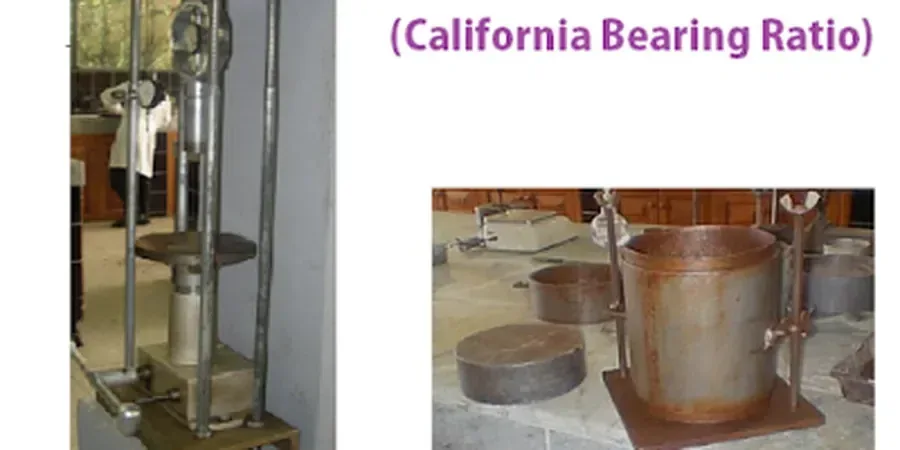
Three-point CBR determination on specimens compacted at optimum moisture content. Includes 96-hour soaking under surcharge, load-penetration curve generation, and correction for concave upward curves. Reported values at 0.1 and 0.2 inch penetration with the higher corrected value designated as the design CBR.
CBR-Moisture Sensitivity Series
CBR testing on identical specimens compacted at moisture contents spanning optimum, optimum +2%, and optimum +4%. This series quantifies the CBR reduction rate with increasing saturation—a critical parameter for Akron subgrades where spring-time groundwater rise is common. Results are plotted as CBR versus molding moisture content for direct use in drainage design.
Stabilized Subgrade CBR Verification
Post-treatment CBR testing on lime- or cement-modified Akron subgrade soils. Specimens are prepared from field-mixed material, cured for the specified period (typically 7 days for cement, 28 days for lime), and subjected to the soaked CBR protocol. Results are compared against ODOT 206 minimum strength requirements for acceptance.
Typical parameters
Questions and answers
What is the difference between soaked and unsoaked CBR, and which one does ODOT require for Akron projects?
The soaked CBR test immerses the compacted specimen in water for 96 hours under a surcharge weight that simulates the overlying pavement mass, producing a strength value representative of the subgrade in its weakest, saturated state. The unsoaked CBR tests the specimen at its molding moisture content without any soaking period. ODOT requires the soaked CBR for pavement design because Akron's seasonal groundwater fluctuations and spring thaw conditions routinely saturate the upper subgrade. An unsoaked value may be 2 to 4 times higher than the soaked value on the same soil, and designing to the unsoaked number will result in a pavement section that is dangerously under-built for the moisture conditions that actually occur in service during the critical spring period.
How much does a laboratory CBR test cost for a pavement project in the Akron area?
A standard soaked CBR test on a single specimen, including compaction, soaking, and penetration testing, typically ranges from US$140 to US$210 per specimen. A full CBR-moisture sensitivity series with three specimens at different moisture contents generally falls in the range of US$420 to US$600. The final cost depends on the number of specimens, the required compactive effort (standard or modified Proctor), and whether companion classification tests such as grain-size analysis and Atterberg limits are included in the testing package.
How many CBR specimens should be tested for a typical Akron road reconstruction project?
ODOT guidelines recommend a minimum of one CBR test per distinct soil type encountered along the alignment, with additional tests spaced at intervals not exceeding 500 feet where the subgrade conditions are uniform. For a typical Akron arterial reconstruction crossing both glacial till uplands and buried valley silt deposits, a testing program would include at least three CBR specimens per soil unit—one at optimum moisture and two at elevated moisture contents—to establish the strength-moisture relationship. Where the subgrade is to be chemically stabilized, additional CBR specimens are required to verify the post-treatment strength gain at the specified curing age.
Can the laboratory CBR value be correlated with other soil strength parameters like the resilient modulus?
Yes, the AASHTO mechanistic-empirical pavement design method uses the resilient modulus (Mr) as the primary subgrade input, and several well-established correlations convert CBR to Mr. The most commonly used in Ohio practice is the equation Mr (psi) = 2555 × CBR^0.64, which is recommended in the 1993 AASHTO Guide for fine-grained soils with soaked CBR values of 10% or less. For granular subgrade materials with higher CBR values, the correlation Mr (psi) = 1500 × CBR is often applied. These correlations are empirical and were developed on a limited set of soil types, so for critical Akron projects with high traffic volumes or where the pavement structure represents a significant investment, we recommend direct resilient modulus testing by the repeated-load triaxial method rather than relying solely on the CBR-to-Mr conversion.