Akron sits at roughly 1,000 feet elevation on the Appalachian Plateau, where subsurface conditions shift from stiff glacial tills to weathered shale within a single block. With a metropolitan population of about 700,000, the city keeps adding mixed-use buildings and industrial expansions that push foundation loads into soils that look competent at first glance but often hide soft lacustrine lenses. Skipping a site-specific SPT program in Akron means guessing bearing capacity on material the last glaciation left behind in unpredictable layers. The Standard Penetration Test (SPT) cuts through that guesswork: a split-spoon sampler driven by a 140-pound hammer falling 30 inches records the N-value every 1.5 feet, and those numbers directly feed IBC Section 1803 foundation parameters. Our team has run hundreds of SPT borings across Summit County, including downtown Akron sites near the Ohio & Erie Canal where fill thickness varies dramatically. Pairing SPT blow counts with grain-size analysis from the same borehole lets us flag liquefiable silts before the structural engineer ever sees the report.
In Akron's glacial stratigraphy, a 12-inch SPT interval can be the difference between spread footings at 4,000 psf and needing deep foundations.
Our approach and scope
Local geotechnical context
Akron lies in Seismic Design Category B per ASCE 7-22, so seismic site class determination becomes the primary regulatory driver for SPT testing here. IBC Table 1613.2.3 requires a minimum of 100 feet of SPT data or shear-wave velocity profiles to assign Site Class C, D, or E. Guessing Site Class D without borings can overestimate the design spectral acceleration by 30 percent, inflating structural steel costs unnecessarily. The bigger liability is missing a Site Class E profile: a shallow soft clay layer with N-values below 10 overlying rock triggers higher seismic coefficients that alter the entire lateral system. The Standard Penetration Test also governs liquefaction screening in Akron's river corridors. We apply the Youd-Idriss (2001) procedure to SPT N1(60) values, and if the factor of safety drops below 1.2 for the design earthquake, the geotechnical recommendation shifts from shallow footings to ground improvement or deep foundations. An SPT program that stops at 20 feet when the site sits on 45 feet of glaciolacustrine silt simply misses the controlling layer.
Regulatory framework
ASTM D1586-18: Standard Test Method for SPT and Split-Barrel Sampling of Soils, IBC 2021 Section 1803: Geotechnical Investigations, ASCE 7-22 Chapter 20: Site Classification Procedure, NCEER/NSF (Youd-Idriss 2001): Liquefaction Resistance of Soils from SPT, Ohio DOT Geotechnical Manual: SPT N-value correlations for bearing capacity
Related services
SPT Borehole Drilling and N-value Logging
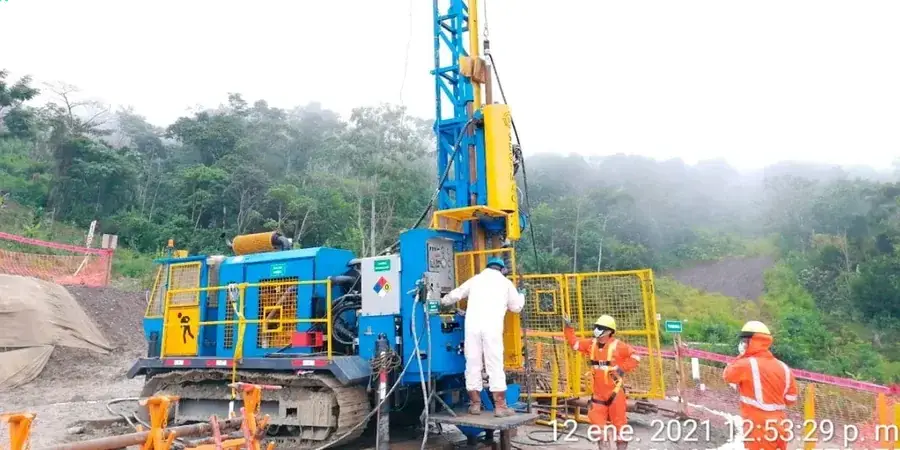
Hollow-stem auger drilling with SPT sampling every 2.5 feet, logged by a staff geologist who classifies the recovery in real time. We provide N60-corrected blow counts, soil descriptions per ASTM D2487, and a boring log ready for the structural engineer's foundation design.
Liquefaction Screening Package
For sites in the Cuyahoga and Tuscarawas River floodplains, we run SPT-based liquefaction analysis per NCEER methodology. Deliverables include cyclic stress ratio plots, factor of safety versus depth, and post-liquefaction settlement estimates for the MCE ground motion.
Bearing Capacity and Settlement Report
Using SPT N60 values correlated to drained friction angle and undrained shear strength, we compute allowable bearing capacity for spread footings and mats per Terzaghi-Meyerhof methods, plus immediate and consolidation settlement estimates keyed to the column load schedule.
Typical parameters
Questions and answers
How much does an SPT boring program cost in Akron?
For a typical Akron project requiring two to three borings to 30 feet, SPT testing generally runs between US$520 and US$700 per boring, including the drilling crew, split-spoon sampling, and the N-value log. Mobilization charges and traffic control in downtown Akron add to the total, and laboratory classification of the split-spoon samples is priced separately per sample. A full geotechnical report with bearing capacity and settlement analysis is quoted based on the number of borings and the project scope.
How many SPT borings does IBC require for a commercial building in Akron?
IBC 2021 Section 1803.3 calls for at least one boring for every 2,500 square feet of building footprint for structures up to 10,000 square feet, with at least two borings minimum. For larger footprints, the spacing increases to one per 5,000 square feet. The Akron building department typically expects borings to extend through the compressible glacial till and into competent shale or dense till, with at least one boring going to 30 feet below the lowest foundation elevation.
What N-value indicates good bearing soil in Akron?
In Akron's glacial till, N-values above 15 to 20 generally correlate to allowable bearing pressures around 3,000 to 4,000 psf for spread footings, provided the soil is above the water table and the N-values are consistent across the boring depth. When N60 exceeds 30 in the upper 10 feet and refusal approaches on shale at 25 to 35 feet, footings can often be designed for 5,000 psf or more, subject to settlement analysis.
Can the SPT detect buried fill or debris on an old Akron industrial site?
The split-spoon sampler recovers a disturbed but visible soil sample, so the geologist logging the boring can identify brick, slag, wood, cinders, or rubber fragments that indicate fill. N-values in fill tend to be erratic: a blow count of 5 in one interval and 40 in the next often signals debris. When the SPT suggests undocumented fill, we recommend supplementing with test pits or a CPT sounding to map the fill thickness and lateral extent more precisely.
How long does an SPT investigation take from drilling to report?
Drilling two 30-foot SPT borings in Akron typically takes one day in the field, assuming normal access and no buried obstructions that require re-drilling. Laboratory classification of the split-spoon samples adds three to five business days. The geotechnical report with N-value logs, bearing capacity, settlement estimates, and liquefaction screening if applicable is usually delivered within 10 to 14 business days after the field work is complete.