Akron sits at roughly 1,000 feet elevation on the Allegheny Plateau, where glacial till and lakebed sediments create a patchwork of silty clays and granular soils that don't always compact the way a standard proctor curve predicts. We've run field density tests on projects from the old Goodyear campus redevelopments to new warehouse pads out by the old Rolling Acres site, and the one constant is that visual inspection of a lift tells you nothing about what's happening six inches down. The sand cone method—ASTM D1556 in our lab protocols—gives us a direct measurement of in-place density that a nuclear gauge can't always nail in Akron's iron-rich clayey fills, which is why contractors keep calling us back when the spec requires a definitive pass/fail on compaction.
A sand cone test on Akron glacial till doesn't lie—the hole, the sand weight, and the moisture sample all tell the same story.
Our approach and scope
Local geotechnical context
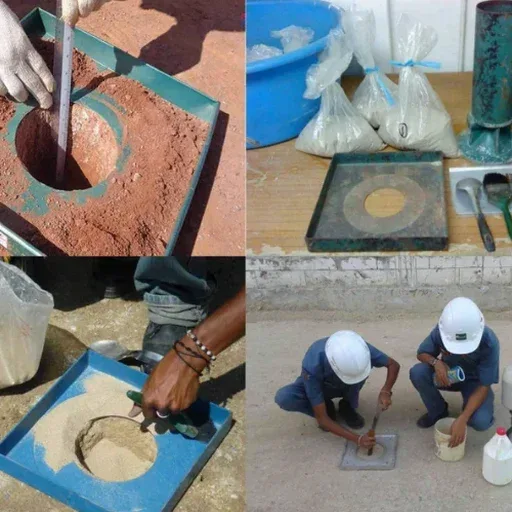
The sand cone apparatus is a simple kit: a double-cone valve assembly, a one-gallon plastic jug of calibrated Ottawa sand, a base plate with a six-inch circular opening, and a field scale that reads to one gram. We carry it out onto Akron job sites in a sturdy case that has seen everything from mud at a Barberton-area levee repair to asphalt millings dust on I-77 widening jobs. The biggest source of error isn't the equipment. It's vibration from nearby compaction equipment jiggling the sand in the hole, or a technician rushing the excavation and disturbing the sidewalls. In northeast Ohio's freeze-thaw climate, we also see density readings shift between morning and afternoon if the top few inches of fill have dried out under August sun, so timing the test relative to placement matters more than most specs acknowledge.
Regulatory framework
ASTM D1556: Standard Test Method for Density and Unit Weight of Soil in Place by Sand-Cone Method, ASTM D698 / D1557: Standard Test Methods for Laboratory Compaction (Standard and Modified Proctor), ODOT CMS 203.04: Ohio DOT compaction control requirements referencing AASHTO T-191
Related services
Compaction verification with sand cone
On-site density testing per ASTM D1556 on building pads, utility trenches, retaining wall backfill, and pavement subgrade throughout the Akron area.
Laboratory Proctor curves
Standard and modified Proctor compaction tests (ASTM D698/D1557) run on your site soil to establish the target density and optimum moisture before field testing begins.
Field moisture determination
Rapid moisture content measurement by microwave or hot-plate method for same-day pass/fail reporting on active earthwork spreads.
Typical parameters
Questions and answers
What does a sand cone density test cost in the Akron area?
A single sand cone test point typically runs between US$100 and US$160, depending on how many points you need in one mobilization and whether we're running a companion Proctor curve. A full day of testing with a technician on site usually falls in the US$800–US$1,200 range. Give us the square footage and lift schedule and we'll quote a flat rate.
Is the sand cone method accepted by Akron building officials and ODOT?
Yes. ASTM D1556 is referenced directly in the Ohio DOT Construction and Material Specifications, and Summit County building departments accept sand cone results for proof-rolling verification and foundation subgrade acceptance. We provide a signed report with calibration data that holds up under plan review.
Can you test through crushed stone or coarse aggregate base?
The sand cone method works best in soils with particles up to about 1.5 inches. For open-graded aggregate base with larger stone, the excavated hole volume becomes less reliable because the sand flows into large voids. In those situations we'll often switch to a water-replacement method or discuss alternative compaction verification approaches with the engineer of record.
How many test points do I need for a commercial building pad in Akron?
It depends on the spec, but a good rule of thumb is one test per 1,500 to 2,500 square feet per lift, with a minimum of three points per lift for anything under 5,000 square feet. If the geotechnical report calls out variable subgrade conditions—common in Akron where glacial till transitions to alluvium over short distances—we may recommend a tighter grid on the first lift to establish a baseline. More info.