Laboratory testing is the cornerstone of geotechnical engineering, providing the quantitative data needed to characterize soil and rock behavior under controlled conditions. In Akron, Ohio, this category encompasses a suite of standardized tests that determine physical and mechanical properties—from particle size distribution to shear strength—essential for safe and economical foundation design, earthwork construction, and slope stability analysis. Without these lab results, engineers would rely on assumptions that could lead to structural failures or costly overdesign.
Akron’s geology is dominated by glacial till, lacustrine deposits, and residual soils derived from the underlying sedimentary bedrock, primarily sandstone and shale of the Pennsylvanian system. The region’s clay-rich soils, often exhibiting high plasticity and shrink-swell potential, require precise grain size analysis to assess drainage and compaction behavior. Additionally, the presence of old buried valleys and variable glacial outwash layers means that soil properties can change dramatically over short distances, making laboratory characterization critical for site-specific solutions.
All laboratory work in Akron must comply with ASTM International standards, which are widely adopted across the United States. For example, ASTM D422 governs sieve and hydrometer analysis, while ASTM D698 and D1557 cover Standard and Modified Proctor tests. These standards ensure consistency and reliability of results, and local projects often reference the Ohio Department of Transportation (ODOT) Supplement 1059 for acceptance criteria on compaction and material quality.
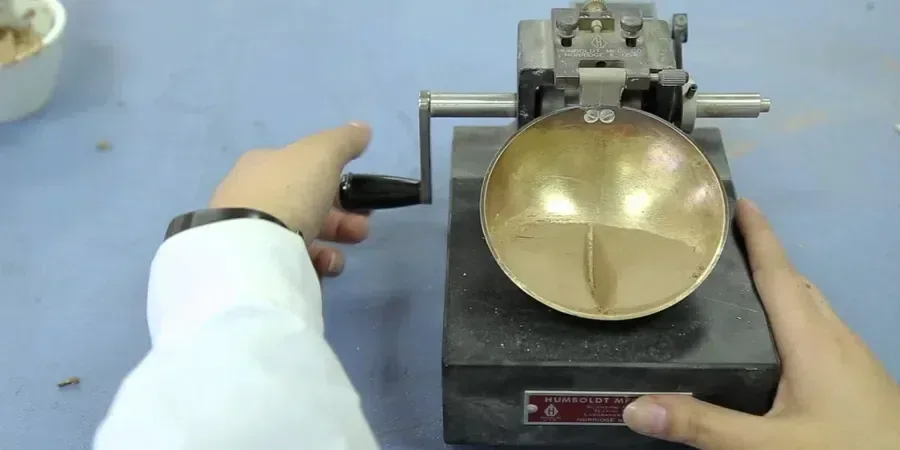
Projects that demand comprehensive laboratory testing include residential and commercial building foundations, roadway embankments, retaining walls, and underground utilities. In Akron’s urban redevelopment areas, such as the Northside District, triaxial tests are frequently used to evaluate undrained shear strength for deep excavations and shoring. Similarly, Atterberg limits are essential for classifying fine-grained soils and predicting their behavior under moisture changes, which is vital for pavement design and landfill liner construction.
Questions and answers
What types of soil samples are typically tested in a geotechnical laboratory in Akron?
In Akron, laboratories commonly test disturbed and undisturbed samples from boreholes and test pits. Disturbed samples are used for grain size and compaction tests, while undisturbed tube samples are preferred for triaxial and consolidation tests to preserve in-situ structure and density.
How long does it usually take to complete a standard suite of laboratory tests?
A standard suite, including grain size analysis, Atterberg limits, and Proctor tests, typically takes 5 to 10 business days. More complex tests like triaxial or consolidation may require 2 to 4 weeks, depending on sample saturation and loading schedules.
Are laboratory test results accepted by local building departments in Akron?
Yes, as long as tests are performed by a certified laboratory following ASTM standards and ODOT specifications. Building departments in Akron and Summit County generally require a stamped geotechnical report that includes lab data for permit approval on foundations and earthwork.
What is the difference between Standard and Modified Proctor tests, and when is each used?
Standard Proctor (ASTM D698) applies a lower compactive effort and is used for projects like residential fills or light load areas. Modified Proctor (ASTM D1557) uses a higher effort and is required for heavy-duty applications such as highway subgrades, airport runways, and large embankments in Akron.