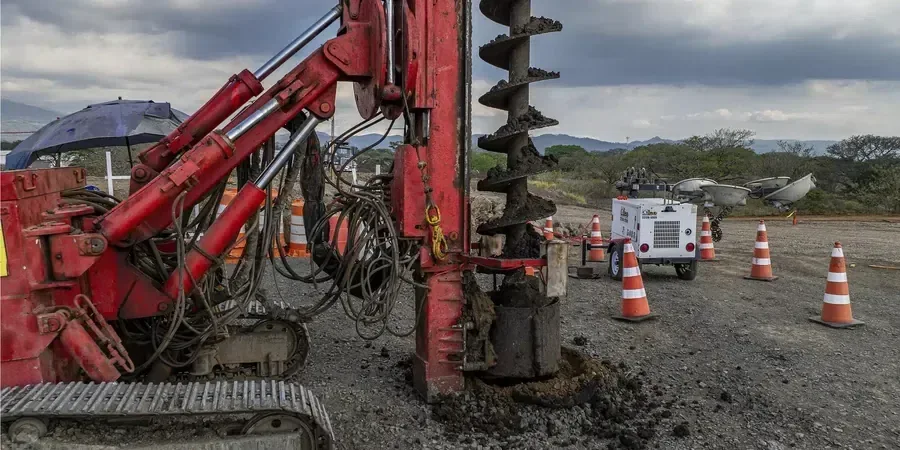
A warehouse expansion on Akron’s east side hit 18 feet of soft silt before reaching competent till. The structural engineer needed a ground improvement solution that didn’t require deep foundations or massive over-excavation. Stone columns made sense—but only if the aggregate locked up correctly and the surrounding soil provided enough confinement. We ran a full laboratory program: grain-size distribution on the native silt, Proctor on three candidate aggregate sources, and consolidated-undrained triaxial tests to confirm the friction angle the designer was counting on. In Akron, where the glacial stratigraphy can flip from stiff clay to loose silt in less than 50 horizontal feet, stone column design without site-specific lab data is guesswork. That’s why our team pairs every vibro-replacement job with testing that feeds directly into Priebe or Balaam-Booker settlement calculations.
Confinement is everything in stone column performance. If the native silt tests below 300 psf undrained, we recommend a load test before finalizing the grid.
Our approach and scope
Local geotechnical context
Akron sits at 1,004 feet above sea level on a dissected plateau where glacial Lake Maumee left behind rhythmically bedded silts and clays. These deposits are notorious for losing strength under cyclic loading—a problem that showed up during the 1986 Painesville earthquake (M5.0) when soft-ground amplification was documented across northeastern Ohio. A stone column grid designed without accounting for post-cyclic strength degradation can settle 40% more than predicted. We run cyclic triaxial tests when the site is within a mapped NEHRP Site Class E or F zone, giving the designer a degraded Su to plug into the settlement model. In Akron’s downtown river corridor, where fill thicknesses exceed 15 feet, we also check for organic lenses that can cause long-term creep even after improvement.
Regulatory framework
IBC Chapter 18 (Soils and Foundations), ASCE 7-22 Section 12.13 (Ground Improvement), ASTM D4767 (CU Triaxial), ASTM D6928 (Aggregate Degradation), FHWA-NHI-16-072 (Ground Improvement Methods)
Related services
Native Soil Characterization
Undisturbed sampling, Atterberg limits, grain-size analysis, and CU triaxial to establish pre-improvement Su, friction angle, and compressibility. We classify per ASTM D2487 and deliver a borehole-by-borehole parameter table.
Aggregate Source Evaluation
L.A. abrasion, sulfate soundness, and gradation checks on candidate stone sources. We test clean crushed limestone from local Akron quarries to confirm the 38°–42° friction angle assumed in design.
Post-Improvement Verification
Modulus and strength testing on composite samples where required, plus data packages formatted for Priebe or Balaam-Booker settlement analysis. We can also support field modulus tests with lab-calibrated correlations.
Typical parameters
Questions and answers
What does stone column design testing cost in Akron?
A complete laboratory program for a typical Akron commercial project runs between US$1,440 and US$5,900, depending on the number of boreholes, triaxial specimens, and aggregate sources evaluated. A basic package with three CU triaxial tests and full index testing on native soil starts near the lower end.
How deep do stone columns need to go in Akron’s glacial soils?
Most Akron projects extend stone columns 15 to 25 feet to reach the stiffer till. We determine the exact depth from the undrained shear strength profile—columns should bottom out where Su exceeds 1,500 psf to provide reliable end bearing and confinement.
Can you test the aggregate before it’s shipped to the site?
Yes. We run gradation, L.A. abrasion, and triaxial tests on aggregate samples from the quarry before the vibro-replacement contractor mobilizes. This lets the designer confirm the friction angle and durability before material arrives on site. More info.