The most frequent mistake we see on Akron job sites is assuming that liquefaction is only a West Coast problem. Engineers look at the glacial till and Lake Erie sediments and skip the seismic chapter. That assumption collapses the moment you hit a loose, saturated sand lens within the Cuyahoga Valley fill sequences. Akron sits in a moderate seismic hazard zone shaped by ancient basement faults, and the combination of shallow groundwater along the Ohio & Erie Canal corridor with silty sand layers creates conditions where cyclic mobility can trigger even at moderate peak ground accelerations. We have reviewed too many foundation designs where nobody ran an SPT-based liquefaction screening, and the result was a project delay measured in months, not days. A proper liquefaction analysis starts with the SPT drilling data, then layers in grain-size distribution from the grain size lab work to calculate the fines content correction the simplified procedure demands.
Liquefaction in Akron is not a theoretical exercise. It is a site-specific calculation where a two-meter-thick loose sand lens at three meters depth can govern the foundation design more than the thirty meters of stiff till above it.
Our approach and scope
Local geotechnical context
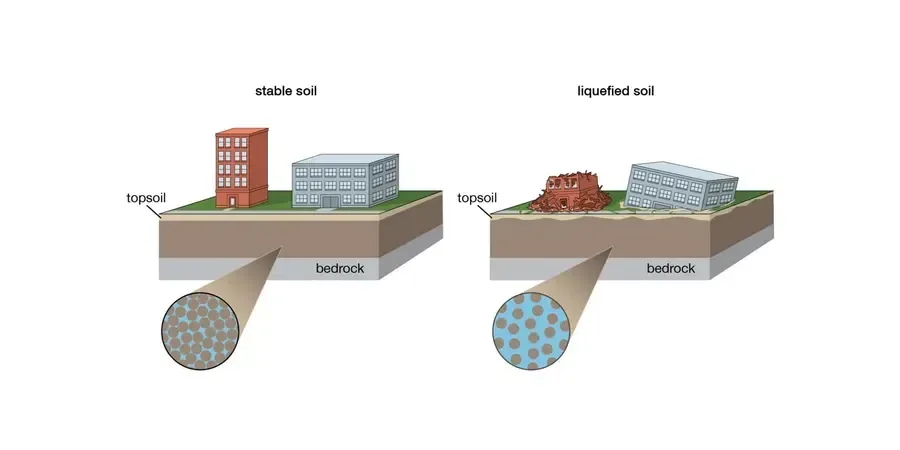
The Cuyahoga River and its tributaries have deposited up to 30 meters of Holocene alluvium beneath Akron's industrial and commercial corridors, including the North Hill and Cascade Valley neighborhoods. These deposits contain discontinuous lenses of loose, poorly graded sand that plot directly in the liquefiable range on a Tsuchida grain-size envelope. We have logged SPT blow counts below 8 in these units at depths between 2.5 and 6.0 meters, right where foundation influence stresses are highest. The risk compounds because Akron's design peak ground acceleration, while modest at around 0.08 to 0.12 g for the 2,475-year return period on rock, amplifies significantly when it travels through soft soil columns. A site-specific response analysis often shows surface accelerations 1.4 to 1.8 times higher than the rock-outcrop value. That amplification, combined with a groundwater table that sits less than 1.2 meters below grade in the valley bottom, means the factor of safety against liquefaction triggering can drop below 1.1 even for a design earthquake event. Without mitigation, post-liquefaction settlements of 50 to 100 millimeters are a realistic outcome, enough to crack grade beams and sever utility connections. We address this risk early, before the structural engineer locks in the foundation type, because the cost of ignoring it multiplies once the excavation is open and the dewatering pumps are running.
Regulatory framework
ASTM D1586-18 Standard Test Method for Standard Penetration Test (SPT) and Split-Barrel Sampling of Soils, ASCE 7-22 Minimum Design Loads and Associated Criteria for Buildings and Other Structures, Chapter 21, IBC 2021 Section 1613 Earthquake Loads and Section 1803 Geotechnical Investigations, NCEER/Youd-Idriss 2001 Liquefaction Resistance of Soils: Summary Report from the 1996 NCEER and 1998 NCEER/NSF Workshops, ASTM D4318 Standard Test Methods for Liquid Limit, Plastic Limit, and Plasticity Index of Soils
Related services
SPT-Based Liquefaction Triggering Analysis
Full simplified procedure calculation using corrected SPT N1,60 values with fines content and overburden corrections. We deliver factor of safety against liquefaction for each critical layer, plus lateral spreading displacement estimates using the Bartlett & Youd empirical model.
Post-Liquefaction Settlement Assessment
Volumetric strain estimation per Ishihara & Yoshimine (1992) and Zhang et al. (2002) CPT-based methods. We provide differential settlement profiles that the structural engineer can use directly for foundation performance checks.
Ground Improvement Feasibility for Liquefaction Mitigation
Comparative analysis of vibrocompaction, stone columns, and compaction grouting for Akron subsurface conditions. We include settlement reduction ratios and post-treatment verification testing specifications.
Typical parameters
Questions and answers
Does Akron really need a liquefaction analysis given the low seismic hazard?
Yes, for certain subsoil profiles. Akron's mapped Ss values are lower than the West Coast, but the presence of loose, saturated granular soils in the Cuyahoga Valley alluvium can trigger liquefaction at moderate accelerations. IBC Section 1613 requires evaluation when Site Class E or F soils are present and the site-adjusted PGA exceeds the screening threshold. We have documented liquefiable layers in more than a dozen Akron borings over the past five years.
What is the typical turnaround time for a liquefaction report in Akron?
A standard scope with 3 to 5 SPT borings and companion laboratory testing runs about 18 to 22 business days from field completion to final report. This includes the time for grain-size distribution, Atterberg limits, and the cyclic stress ratio calculations. Expedited schedules are possible when the drilling crew can mobilize within the same week.
How much does a liquefaction analysis cost for a typical Akron commercial lot?
For a standard commercial site in Akron requiring 3 to 4 SPT borings with laboratory index testing and a full liquefaction triggering report, budgets typically range from US$2,820 to US$3,580. The final figure depends on boring depth, number of samples tested for fines content, and whether a site-specific response analysis is required.
Which ground improvement methods work best for Akron's glacial soils?
Stone columns and vibrocompaction are the most effective liquefaction countermeasures for the loose outwash sands found in Akron. Stone columns provide drainage and densification, while vibrocompaction is efficient for cleaner sands with less than 15 percent fines. We evaluate the grain-size envelope and depth to groundwater to recommend the method that will achieve the target post-treatment SPT N1,60 values.