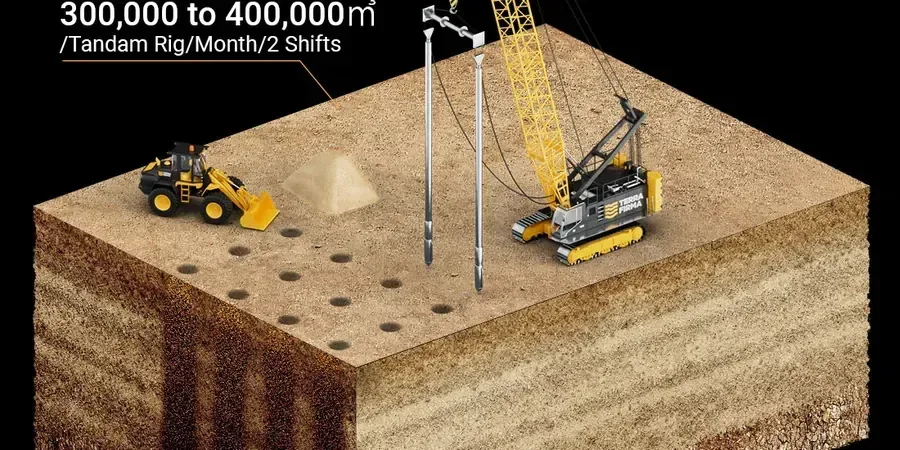
A warehouse expansion near the Little Cuyahoga River encountered six feet of loose silty sand over glacial till. The geotechnical report called for a minimum 70% relative density under footings, but standard compaction couldn't reach that depth. Vibrocompaction design became the solution. We modeled the grid spacing using water table data from nearby monitoring wells and vibroflot specifications suited to Akron's layered overburden. The approach integrates energy input per probe, sand backfill gradation, and real-time ammeter records. For sites with high fines content, we cross-check densification potential with CPT testing to confirm cone resistance improvement before construction.
Grid spacing is not a guess. It's an equation balancing vibrator power, soil grain size, and target relative density.
Our approach and scope
Local geotechnical context
A common mistake is specifying vibrocompaction without running a pre-production test section on Akron's variable fill. Glacial environments here can hide old buried channels or debris pockets that vibrate differently than the surrounding matrix. One site in North Akron had a 20-foot lens of cinder fill from a demolished factory; the vibrator sank uncontrollably and the ammeter never stabilized. The design had to be revised on the fly, adding stone columns in that area. Skipping the test section also means missing the optimal probe spacing. Too wide and density stays low. Too tight and costs double with no added benefit. We require at least three probes at the start to validate amperage build-up curves and settlement readings before locking the grid.
Regulatory framework
FHWA-NHI-06-088 (Ground Improvement Methods), ASTM D1586 (SPT correlation for relative density), ASTM D2487 (Soil classification for fines content check), ASCE 7-22 (Seismic design parameters for improved ground)
Related services
Vibrocompaction Feasibility & Design
We evaluate grain size curves, SPT/CPT logs, and groundwater levels to determine if deep vibratory compaction fits your Akron site. The design deliverable includes grid layout, energy targets, backfill specs, and acceptance criteria tied to post-treatment SPT or CPT verification.
Test Section & QC Monitoring
We supervise the test section with real-time ammeter recording and surface settlement markers. After compaction, we conduct verification testing—usually SPT borings at grid centroids—to confirm Dr meets the design value before production probes begin.
Typical parameters
Questions and answers
What does vibrocompaction design cost for an Akron project?
Design fees for a typical Akron warehouse or commercial lot range from US$1,590 to US$5,640, depending on site size, number of probes, and required verification testing. A small site under half an acre with standard soil conditions sits at the lower end. Larger industrial parcels needing multiple test sections and detailed CPT correlation fall at the higher end.
At what depth does vibrocompaction stop being effective in Akron soils?
Most vibroflot rigs in this region compact effectively to 40 feet, which covers the typical loose alluvial zone in Akron's river valleys. Deeper deposits exist near buried bedrock valleys, but beyond 45-50 feet, the vibrator follow-up force and stone backfill delivery become limiting. For deeper treatment, we evaluate alternative methods like stone columns.
How do you verify compaction after treatment?
We use SPT borings at the centroid of the compaction grid, typically one test per 2,500 square feet of treated area. The N-values must meet the design target—usually N60 above 20-25 for the specified depth. For critical structures, we add CPT soundings because the continuous profile catches thin unimproved layers that SPT might miss.