Half the calls we get from contractors in Akron start the same way: they hit a pocket of soft gray clay five feet down and the spread footings that looked fine on paper suddenly need to be three times wider. That is exactly where a raft or mat foundation starts making sense. We have worked on projects from the Merriman Valley up to Goodyear Heights, and the soil profile can change in the span of a single block. The city sits on a mix of glacial till, outwash sands, and lacustrine silts left by the retreat of the Wisconsinan ice sheet, which means bearing capacity is rarely uniform. A properly designed mat foundation bridges those weak spots, distributing column loads across the entire footprint. The approach is not to fight the variability but to work with it, something we have learned from years of correlating lab data from grain size analysis and Atterberg limits with actual settlement readings on completed slabs.
A mat foundation does not eliminate settlement; it redistributes it so the structure moves as a unit instead of cracking at every cold joint.
Our approach and scope
Local geotechnical context
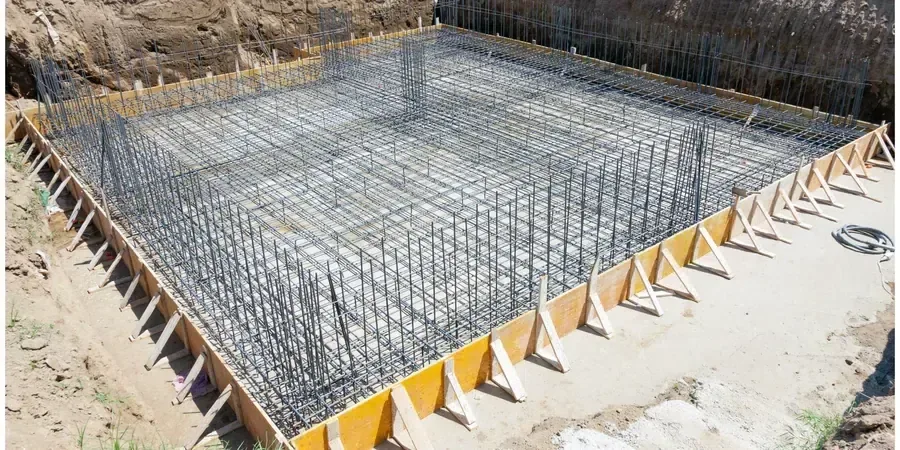
The mistake we see too often in Akron is designing a mat as if it were just a thick slab on grade, ignoring the flexural demands from soil-structure interaction. A contractor pours a uniform twelve-inch mat with a single layer of welded wire mesh, and two winters later the perimeter has heaved while the interior settled, opening up cracks that run straight through partition walls. The real cost is not in the extra concrete or rebar, it is in the forensic investigation and underpinning that comes after the drywall is already painted. Another recurring problem happens when the excavation exposes the subgrade to November rain and the clay swells before the mud mat is placed. We insist on protecting the bearing surface with a lean concrete blinding layer placed within hours of final trim, and we specify a perimeter drain system that keeps the mat from sitting in perched water during the spring thaw. These are details that do not show up in a standard software output but make the difference between a foundation that performs for thirty years and one that starts moving in the first freeze-thaw cycle.
Regulatory framework
ACI 318-19: Structural Concrete for Buildings, ASCE 7-22: Minimum Design Loads for Buildings, IBC 2024, Chapter 18: Soils and Foundations, ASTM D1586-18: Standard Penetration Test (SPT), ASTM D2487-17: Unified Soil Classification System
Related services
Subgrade investigation and soil parameter derivation
We run SPT borings, collect undisturbed Shelby tube samples, and perform laboratory consolidation and triaxial tests to define the modulus of subgrade reaction and bearing capacity specifically for your site.
Structural analysis and reinforcement design of the mat
Using finite element models calibrated with local soil data, we design the mat thickness, reinforcement layout, and construction joints to satisfy ACI 318 and IBC requirements for flexure, shear, and punching.
Construction-phase monitoring and plate load verification
We conduct field plate load tests on the prepared subgrade before the concrete pour, verifying that the achieved subgrade modulus meets or exceeds the design assumptions.
Typical parameters
Questions and answers
When does a mat foundation make more sense than isolated footings for a project in Akron?
When the allowable bearing pressure drops below about 2,500 psf, or the combined footing area exceeds 50 percent of the building footprint, a mat usually becomes the more economical solution. In Akron, this often happens where the glacial till transitions to softer lakebed silts and clays.
What is the typical cost range for a raft/mat foundation design in the Akron area?
For a typical commercial or multi-family residential project in Summit County, the structural and geotechnical design package for a mat foundation generally falls between US$1,090 and US$4,530, depending on the footprint size and the complexity of the soil profile.
How do you handle the freeze-thaw risk with a mat foundation in Ohio?
We set the underside of the mat at least 42 inches below finished grade, which is the frost depth for this part of Ohio. We also specify a perimeter insulation detail and a free-draining granular base with a positive drainage path to daylight or a sump.
What soil tests are absolutely necessary before designing a mat in the Akron area?
At minimum, we need SPT borings distributed across the footprint to map the stratigraphy, plus laboratory consolidation tests on undisturbed samples of the compressible layers to estimate settlement magnitude and rate. If the water table is high, we add permeability tests to size the underslab drainage.
Can a mat foundation be combined with a basement in Akron?
Absolutely. We design the mat as the base slab of the basement, with the walls acting as stiffening beams. The key is accounting for the lateral earth pressure on the walls while the mat is distributing vertical loads, and ensuring the waterproofing system is compatible with the structural movements we anticipate.