A few years back, during the reconstruction of a commercial building near the University of Akron, we were called in after the excavation for a basement parking level kept filling with water. The contractor had assumed the soil would be a uniform clay, but the glacial stratigraphy in this part of Summit County told a different story—interbedded silty clay and sand lenses were channeling groundwater directly into the cut. Designing a retaining wall here is rarely a plug-and-play exercise. The advance and retreat of the Wisconsinan ice sheet left behind a complex mosaic of tills, lacustrine silts, and outwash deposits that can change within a few hundred feet. A wall that works on the north side of the Cuyahoga River may require a fundamentally different drainage and reinforcement strategy just a mile south. We approach each project by first mapping the local stratigraphy with targeted subsurface exploration, often combining Standard Penetration Tests per ASTM D1586 with laboratory classification to understand the soil’s true character before any structural calculations begin.
In Akron's glacial terrain, the difference between a wall that lasts 50 years and one that fails in five is rarely the concrete strength—it's the drainage detail behind it.
Our approach and scope
Local geotechnical context
Akron's development history—from the Ohio & Erie Canal era through the rubber industry boom—left a legacy of urban fill and re-graded slopes that complicate retaining wall design. The city’s older neighborhoods, particularly those along the Little Cuyahoga Valley, often sit on layers of industrial debris, cinders, and miscellaneous fill that were placed without compaction decades before modern codes existed. When a new wall is founded on these materials, differential settlement becomes a primary concern, potentially cracking a rigid concrete structure within the first freeze-thaw cycle. We address this by extending the foundation investigation deeper than the visible fill layer, often into the competent glacial till beneath, and by considering flexible wall systems like mechanically stabilized earth (MSE) that can tolerate some movement without structural distress. The groundwater regime also reflects historical alteration—buried stream channels and disconnected drainage from demolished structures can introduce water pressure against a wall in ways that a standard boring log won’t predict unless the site’s historical context is researched.
Regulatory framework
ASCE 7-22 Minimum Design Loads for Buildings and Other Structures, IBC 2021 Chapter 18 Soils and Foundations, ASTM D1586-18 Standard Test Method for Standard Penetration Test (SPT), ASTM D2487-17 Standard Practice for Classification of Soils (Unified Soil Classification System), AASHTO LRFD Bridge Design Specifications (for walls supporting roadways)
Related services
Lateral Earth Pressure Analysis
We compute active, at-rest, and passive pressure distributions using site-specific soil parameters from laboratory direct shear or triaxial tests, accounting for surcharge loads from adjacent structures and sloping backfill.
Global Stability and Bearing Capacity Checks
Using limit equilibrium software, we evaluate the wall-soil system for rotational and translational failure modes, including the influence of the 48-inch frost penetration zone on shallow foundation elements.
Drainage System Design and Specification
We develop detailed plans for granular drains, geocomposite chimney drains, and outlet details that prevent fine-grained glacial soil migration, specifying materials per ASTM D448 and AASHTO M-288 for filtration compatibility.
Typical parameters
Questions and answers
What type of retaining wall is most suitable for the clay-rich glacial soils found in the Akron area?
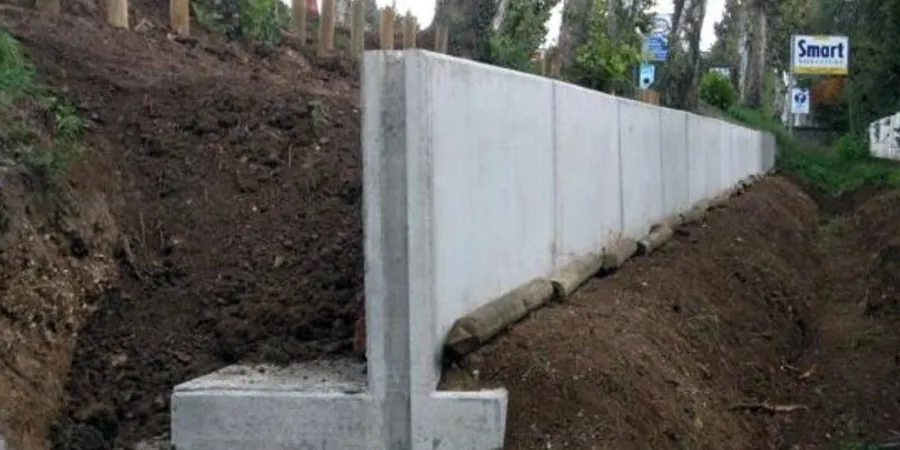
The choice depends heavily on the height of the wall and the groundwater conditions. For walls under 10 feet, a reinforced concrete cantilever wall with a properly designed granular backfill wedge and toe drain often performs well if founded on the stiffer glacial till layer. For taller walls or sites with poor drainage, mechanically stabilized earth (MSE) walls offer more flexibility and better tolerance of the seasonal volume changes that characterize Akron's silty clays. The key is extending the foundation investigation deep enough to identify whether the stiff till is continuous beneath the site, because a thin hard layer over softer lacustrine silt can create a false sense of security.
How does the 48-inch frost depth requirement in Summit County affect retaining wall foundation design?
The frost depth requirement means that the base of the wall footing, or the lowest level of structural fill for an MSE wall, must extend below that 48-inch line to prevent frost heave from lifting and cracking the wall. In Akron's silty soils, which are moderately frost-susceptible, the heave forces can be substantial. We specify non-frost-susceptible granular material for the foundation zone and ensure that drainage paths don't allow water to pond within the frost penetration zone, because saturated silt freezing against a wall stem can generate lateral pressures far exceeding the design earth pressure.
What does retaining wall design typically cost for a residential or small commercial project in Akron?
For a typical residential or light commercial retaining wall in the Akron area, the geotechnical investigation and design package generally falls in the range of US$1,080 to US$3,920. The final cost depends on the wall height, the number of borings required to characterize the site soils, and whether additional laboratory testing like direct shear or consolidation is needed to refine the earth pressure parameters. Sites with complex groundwater conditions or requiring global stability modeling for steep slopes will be at the higher end of that range. More info.